












On March 14–15, 2025, Ms. Fang Yuan’an, Programme Coordinator at UNESCO International Research and Training Centre for Rural Education (INRULED), attended the Rural Education Research Conference 2025 in Australia and presented INRULED’s conceptual framework on education for sustainable development and relevant work. She also visited the Center for Sustainable Communities at the University of Canberra to explore potential cooperation opportunities.
The Conference was initiated by the Australian Association for Research in Education Rural Education Special Interest Group (Rural Education SIG) and hosted by the University of Canberra’s Centre for Sustainable Communities. This year’s theme is “Where are we going in rural education research? Current and new research directions”. During the conference, the new book Sharing Leadership Stories in Rural Education was also launched. This year’s edition has been built on the knowledge accumulated from the first symposium initiated by the Rural Education SIG in 2014 and reflected the progress on rural education research over the past decade.
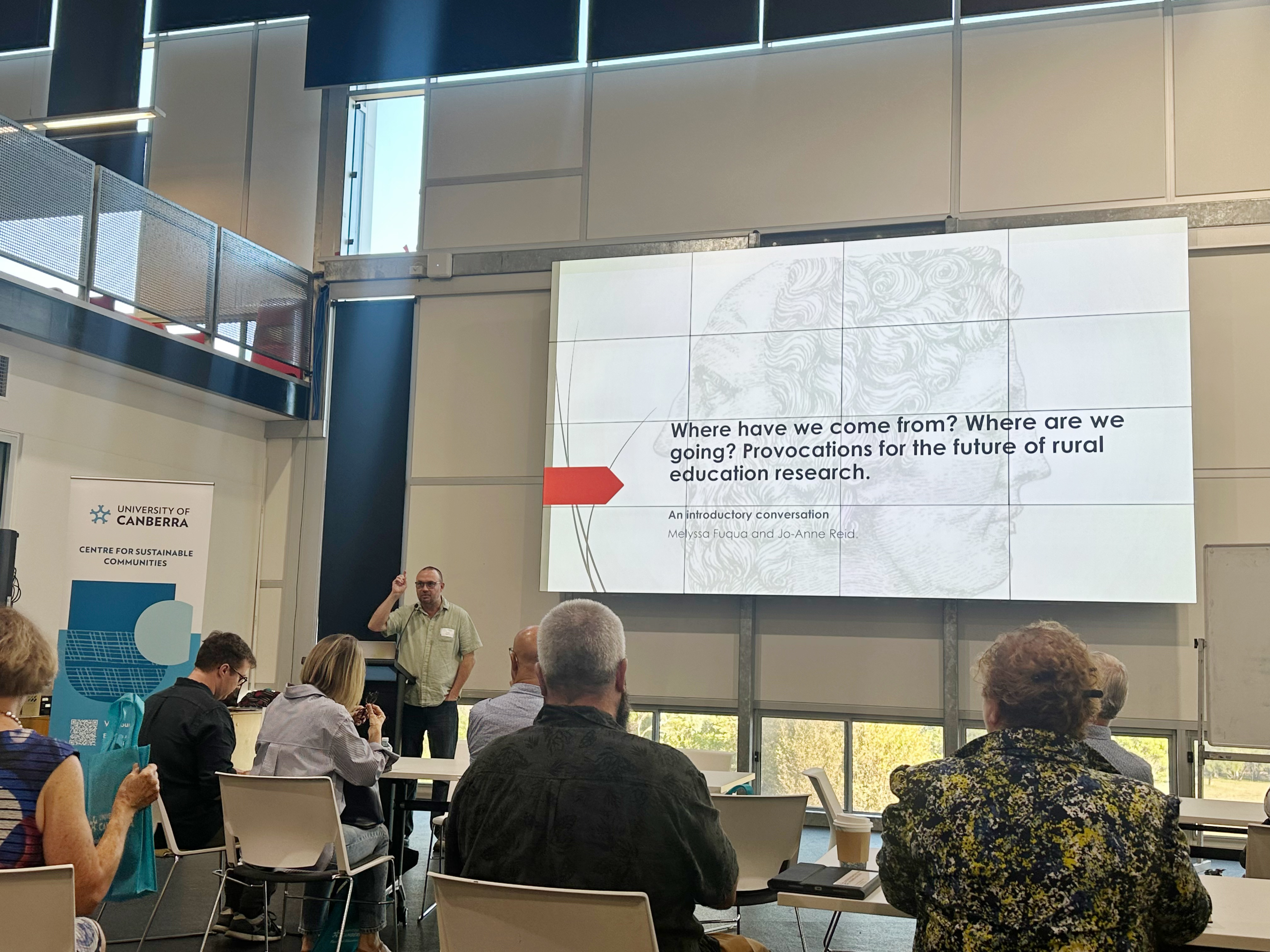
The Symposium special issue by the Australian and International Journal of Rural Education proposed the question of “What next for rural education research” (Roberts & Cuervo, 2015), pointing out that rural education research was dominated by a few major research trends, such as teachers’ attraction to and retention in rural schools; issues of disadvantage in schooling outcomes; and unequal access to tertiary education pathways for regional, rural, and remote students. It also critiqued the tendency to conceive rural education as “deficit” in comparison to urban metrics and trends. Ten years onward, rural education research has significantly expanded its epistemological and research avenues of inquiry. It is noted in the Conference concept note that “aided and influenced by interdisciplinary forces such as sociology, geography, philosophy, and psychology, rural education research has diversified its research agenda into curriculum, gifted education, equity and justice, family and community connections, schooling in remote areas, teacher education, place-based education, youth aspirations and mobility, the link between schooling and tertiary education, and the role and idea of place, among other themes”. Within such context, the Conference aimed to review progress in rural education research over the past decade, break theoretical and empirical boundaries, and explore future directions.
The open call for submissions attracted scholars from over 20 universities and institutions across Australia, the U.S., Sweden, China, and other countries, featuring more than 40 presentations. Most presenters were from Australia, with representatives from every state and territory except Western Australia, reflecting the nation’s strong engagement with rural education research. Discussions delved into topics such as rural teacher recruitment and retention, student mobility and aspirations, indigenous education and curriculum development, community- and place-based research methods, rural knowledge, and educational equity.
A notable contribution came from Professor Philip Roberts of the University of Canberra, whose research critically examined the traditional “deficit” discourse in rural education. Introducing and unfolding concepts like “spatial justice” and “rural knowledge”, he challenged the narrative of rural education as “backward” and instead emphasized its unique spatial and place-based strengths. The conference also showcased innovative initiatives like Australia’s “Regional University Study Hubs”, highlighting policy updates in promoting educational equity. Overall, the discussions demonstrated the growing diversity of rural education research in terms of themes, methodologies, theoretical and practical approaches, especially across Australia.
At the conference, INRULED presented its conceptual framework of “Education for Sustainable Rural Development” and introduced its key projects for the year. INRULED’s work closely aligned with the conference theme, offering practical pathways for advancing rural education. Additionally, INRULED’s projects—such as rural community learning centers, learning villages in the digital era, and TVET workshops—enriched the overall discussion with practical work on underdiscussed topics such as community learning, lifelong learning and digital transformation in education, receiving wide interests and collaboration inquiry among attendees.